


Recommended Services


Supported Scripts
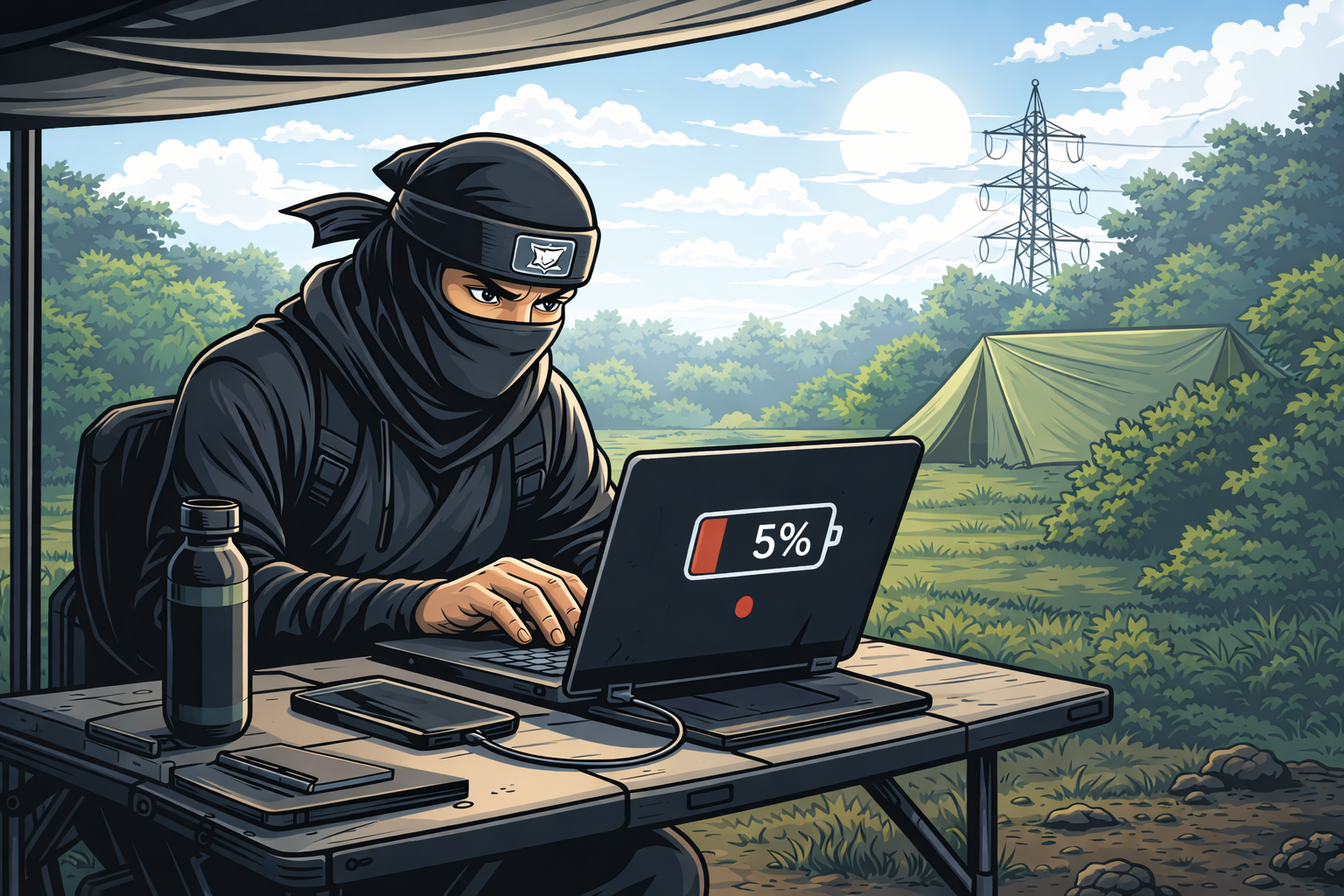

This is the part nobody explains when they talk about mobile work, remote setups, or working outside a fixed office.
Power is not abstract.
Power is not background infrastructure.
Power is not “handled”.
Power is a number on a screen, and that number decides what kind of day you are going to have.
When your office depends on a battery percentage, the way you work changes immediately. Not in a motivational way. In a mechanical, unforgiving way.
Power Turns Work Into a Finite Resource
In a normal office, power is assumed. You do not think about it. You open tabs, leave tools running, spin up builds, jump on calls, recharge devices without friction.
The moment your office runs on batteries, power becomes a budget.
Every action has a cost:
- Video calls cost more than email
- Builds cost more than writing
- Screens cost more than keyboards
- Leaving things open costs more than closing them
You stop asking “what do I feel like doing” and start asking “what can I afford to do”.
That single shift kills a lot of bad habits instantly.
Urgency Becomes Real, Not Artificial
Most urgency in office environments is fake. Slack messages. Meetings. Status updates. None of them actually threaten the ability to work.
Battery does.
If you ignore it, work does not slow down. It stops.
That creates a different prioritisation model:
- Critical work moves earlier
- Optional work gets cut
- “Nice to have” disappears
- Decisions get faster
There is no time for perfection when power is finite. You ship what matters.
Tool Choice Stops Being Theoretical
When power is limited, tools are no longer chosen based on features or popularity. They are chosen based on behaviour.
You start noticing things like:
- Which apps idle aggressively
- Which browsers leak memory
- Which tools refuse to sleep
- Which setups recover cleanly after shutdown
Heavy tools stop being impressive. They become liabilities.
Lightweight, predictable tools win every time.
You also learn very quickly which workflows tolerate interruption and which ones do not. Anything that corrupts state or loses context when power drops gets redesigned or removed.
Meetings Become Expensive
A video call is no longer “just a call”. It is a power commitment.
That forces brutal clarity:
- Is this meeting worth the power cost?
- Can this be async?
- Can this be text?
- Can this wait?
The result is fewer meetings and better communication. Not because of culture, but because physics enforces it.
People who cannot operate without constant live interaction become obvious immediately.
Workdays Get Shaped by Power Curves
You stop thinking in hours and start thinking in power phases.
High battery:
- Heavy tasks
- Compiles
- Calls
- Deployments
Mid battery:
- Writing
- Planning
- Reviewing
- Documentation
Low battery:
- Offline tasks
- Reading
- Notes
- Thinking work
This is not a productivity hack. It is survival.
Ironically, this produces cleaner days than most office schedules. You are forced to match task intensity to available resources instead of pretending everything is equal.
Redundancy Stops Being Optional
Once power becomes visible, redundancy becomes non negotiable.
You do not rely on:
- One charger
- One cable
- One battery
- One device
You assume failure and design around it.
That mindset bleeds into everything else. Backups improve. Offline access improves. Recovery plans become real instead of theoretical.
People talk about resilience. Power constraints force you to practice it.
You Stop Romanticising Work
There is nothing aesthetic about watching a percentage tick down while you are mid task.
It removes fantasy fast.
You do not “push through”. You plan better next time.
You learn when to stop, not because someone tells you to, but because stopping early keeps tomorrow viable.
That discipline carries over even when power is abundant again. You do not forget what it feels like to lose it.
Why This Changes How You Build Systems
Once you work this way, you stop designing systems that assume:
- Infinite uptime
- Continuous connectivity
- Endless resources
- Perfect conditions
You start designing systems that:
- Pause cleanly
- Resume safely
- Fail predictably
- Degrade gracefully
That mindset is rare in comfortable environments. Battery dependency forces it.
The Uncomfortable Truth
Most people are not inefficient because they lack tools or motivation. They are inefficient because nothing forces them to care.
Battery does.
When your office depends on a battery percentage, work stops being performative. It becomes intentional. Every action earns its place.
And once you experience that, it is very hard to go back to pretending power is infinite and time does not matter.
If you want systems built for reality instead of perfect conditions, this is exactly how we approach
VPS infrastructure,
hosting environments, and
automation systems.