


Contact Info
106 Anne Rd, Knoxfield VIC 3180, Australia
+61 (03) 82023009
info@ninjaweb.com.au
Contact usRecommended Services


Supported Scripts
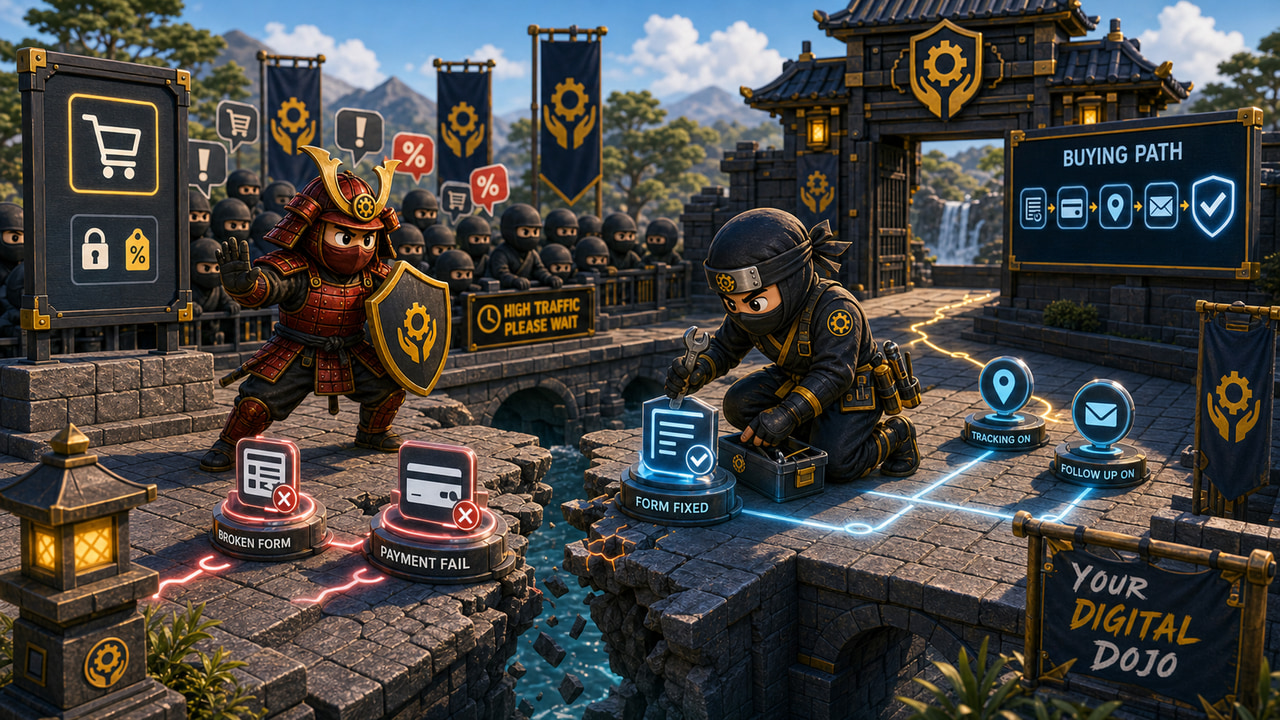

Black Friday Checkout is where a campaign stops being marketing and becomes operations. Traffic can look exciting in reports, but the sale is decided in the last few screens: product page, cart, checkout, payment, confirmation, and follow-up.
This is why a broken buying path cannot be saved by more visitors. If people arrive ready to buy and the checkout creates doubt, every extra click only exposes the weakness faster. Black Friday makes that visible because the pressure arrives in a short window. Customers compare quickly, abandon quickly, and rarely explain what made them leave.
A strong offer still needs a boring path underneath it. The checkout has to load, explain, reassure, accept payment, confirm the order, and pass the job into the business without confusion.
The offer is not the system
Many businesses prepare the visible campaign first. They polish the discount, write the social copy, update banners, and adjust product pages. That work matters, but it does not prove the buying path can handle attention.
The checkout is a different kind of asset. It connects hosting, forms, payment gateways, plugins, email delivery, stock rules, analytics, tracking, fulfilment, and customer support. If one part is weak, the buyer feels it as friction. They do not care which plugin caused it.
Before a campaign goes live, the useful question is not only whether the offer is attractive. The useful question is whether the business can safely accept the attention it is asking for.
Where buyers lose confidence
Checkout failure is not always a full crash. Sometimes the page is slow after the buyer clicks payment. Sometimes shipping costs appear too late. Sometimes coupon logic behaves strangely. Sometimes the confirmation email lands in spam. Sometimes the mobile layout makes one field hard to complete.
Those are small technical details from the business side. From the customer’s side they feel like risk. A buyer who was ready a few seconds ago starts wondering whether the business is organised enough to trust.
- The cart total must be clear before payment.
- Payment errors must be understandable, not cryptic.
- Checkout must work on mobile without awkward fields.
- Confirmation emails must arrive quickly.
- Staff must know where new orders and enquiries land.
That is why checkout readiness belongs beside managed WordPress hosting, security, uptime, and support. It is not just a design problem.
Speed matters, but sequence matters more
A faster checkout is useful, but speed alone does not fix a confusing path. If the buyer sees unclear delivery information, weak trust signals, missing return details, or a payment page that behaves differently from the rest of the site, the page can load quickly and still lose the sale.
The correct sequence is diagnosis before promotion. Walk through the buying path like a customer. Add a product. Use a coupon. Try mobile. Try a failed payment. Check the confirmation message. Check the email. Check the staff handoff. That one pass usually finds more useful work than another banner variation.
For WooCommerce or WordPress-based shops, this also means checking plugin conflicts before the traffic spike. A campaign is a bad time to discover that a checkout plugin, cache setting, security rule, or payment integration was only working under normal load.
Black Friday exposes weak ownership
The buying path usually crosses more than one owner. Marketing owns the offer. The website owner controls the pages. The payment provider owns the transaction. The warehouse or service team handles delivery. Support answers questions. If nobody owns the whole path, Black Friday turns that gap into a visible problem.
This is where business systems matter. A campaign should have a named person watching orders, a fallback path if payment fails, a support response for confused buyers, and a simple way to spot errors early.
Without that ownership, the business can get traffic, lose orders, and still not know exactly where the money leaked.
What to fix before pushing traffic
NinjaWeb would treat the checkout as a system, not a button. The check would include hosting load, plugin behaviour, payment flow, form validation, mobile usability, confirmation email, tracking, internal notifications, and the recovery path for failed orders.
The best Black Friday preparation is not dramatic. It is practical. Test the path while there is still time to fix it. Remove unclear steps. Make the confirmation useful. Give staff ownership. Make sure the business knows when something goes wrong.
Traffic does not save a broken buying path. It only sends more people into it. A serious campaign deserves a checkout that can carry the sale all the way through.