


Contact Info
106 Anne Rd, Knoxfield VIC 3180, Australia
+61 (03) 82023009
info@ninjaweb.com.au
Contact usRecommended Services


Supported Scripts
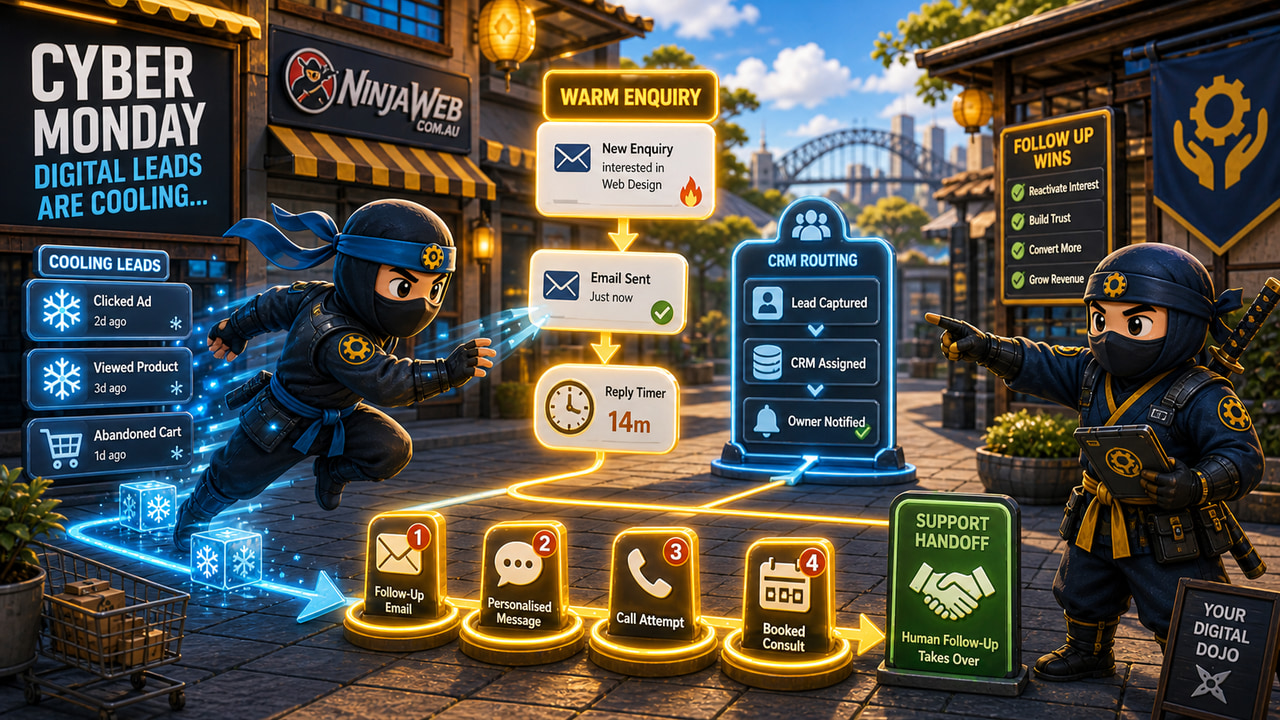

Cyber Monday Follow-Up is the part of the campaign most businesses underestimate. The first click gets attention, but the follow-up decides whether that attention becomes revenue, a quote, a repeat order, or a customer who quietly forgets why they came to the site.
Cyber Monday creates a strange kind of urgency. People browse fast, compare fast, and often leave with half a decision made. Some fill out a form. Some add to cart and stop. Some ask a question. Some click from social and come back later from search. If the business has no follow-up system, those signals cool quickly.
The problem is not that the campaign failed. The problem is that the campaign created leads the business was not ready to handle.
A lead is not finished when the form submits
Many businesses treat the enquiry form as the end of the website’s job. The customer filled it in, the email arrived, and now someone will reply. That is a fragile handoff during a normal week and a dangerous one during a campaign.
A serious follow-up path answers three questions immediately: who owns the enquiry, what happens next, and how fast the customer should expect a response. If those answers depend on whoever happens to check an inbox, the campaign is exposed.
This is especially true for service businesses. A Cyber Monday offer can create conversations, not only instant purchases. If those conversations are slow, vague, or inconsistent, the buyer’s interest fades before the business has a chance to qualify it.
Warm leads go cold in ordinary systems
Most lead loss is not dramatic. It happens inside ordinary tools. A form email lands in a shared mailbox. A staff member opens it but cannot answer yet. A quote request needs more detail. A social message arrives outside business hours. A cart reminder never fires. Nobody records the reason the lead came in.
By the next day, the buyer has moved on. They may still need the service, but the emotional momentum is gone. The business now has to work harder to restart a conversation that should have been handled while it was warm.
- Send a useful confirmation immediately.
- Route the enquiry to a named owner.
- Separate buyers from casual browsers.
- Record the campaign source and offer context.
- Follow up with a human message before the lead cools.
This is where AI automation can help, but only when the workflow is clear. Automation should support ownership, not replace it.
The website should prepare the conversation
A good campaign page does more than capture a name and email. It gives the buyer enough context to make the next conversation easier. That might include package limits, response windows, delivery expectations, service areas, booking rules, or what information the business needs before quoting.
If the page is vague, the follow-up becomes harder. Staff have to ask basic questions. The buyer has to repeat themselves. The offer begins to feel less organised than it looked in the campaign.
Cyber Monday is a good time to look at the entire path from click to response. The page, form, confirmation, internal notification, CRM note, and staff reply should all carry the same message. If they do not, the business feels disjointed.
Fast does not mean careless
There is a difference between fast follow-up and rushed follow-up. A rushed response says very little, answers the wrong thing, or pushes the buyer before the problem is understood. A fast response acknowledges the enquiry, confirms the next step, and makes the customer feel that the business has control.
That control can be simple. A clear acknowledgement. A useful question. A booking link. A quote checklist. A note that a real person will review the request. What matters is that the buyer does not feel abandoned after taking action.
NinjaWeb often treats this as a combined website and operations issue. The front end captures the signal. The system behind it decides whether the signal becomes a conversation.
Build the follow-up before the next campaign
For a Cyber Monday campaign, the practical fix is not another discount. It is a lead path that stays warm after the click. That includes the form, the notification, the owner, the response script, the tracking, and the fallback if the first response does not happen.
Business systems and website work meet at this point. The site should not only attract the lead. It should help the business act on it while the buyer still cares.
Do not let digital leads go cold because the campaign ended at the submit button. The real campaign continues until the buyer gets a clear next step.