


Contact Info
106 Anne Rd, Knoxfield VIC 3180, Australia
+61 (03) 82023009
info@ninjaweb.com.au
Contact usRecommended Services


Supported Scripts
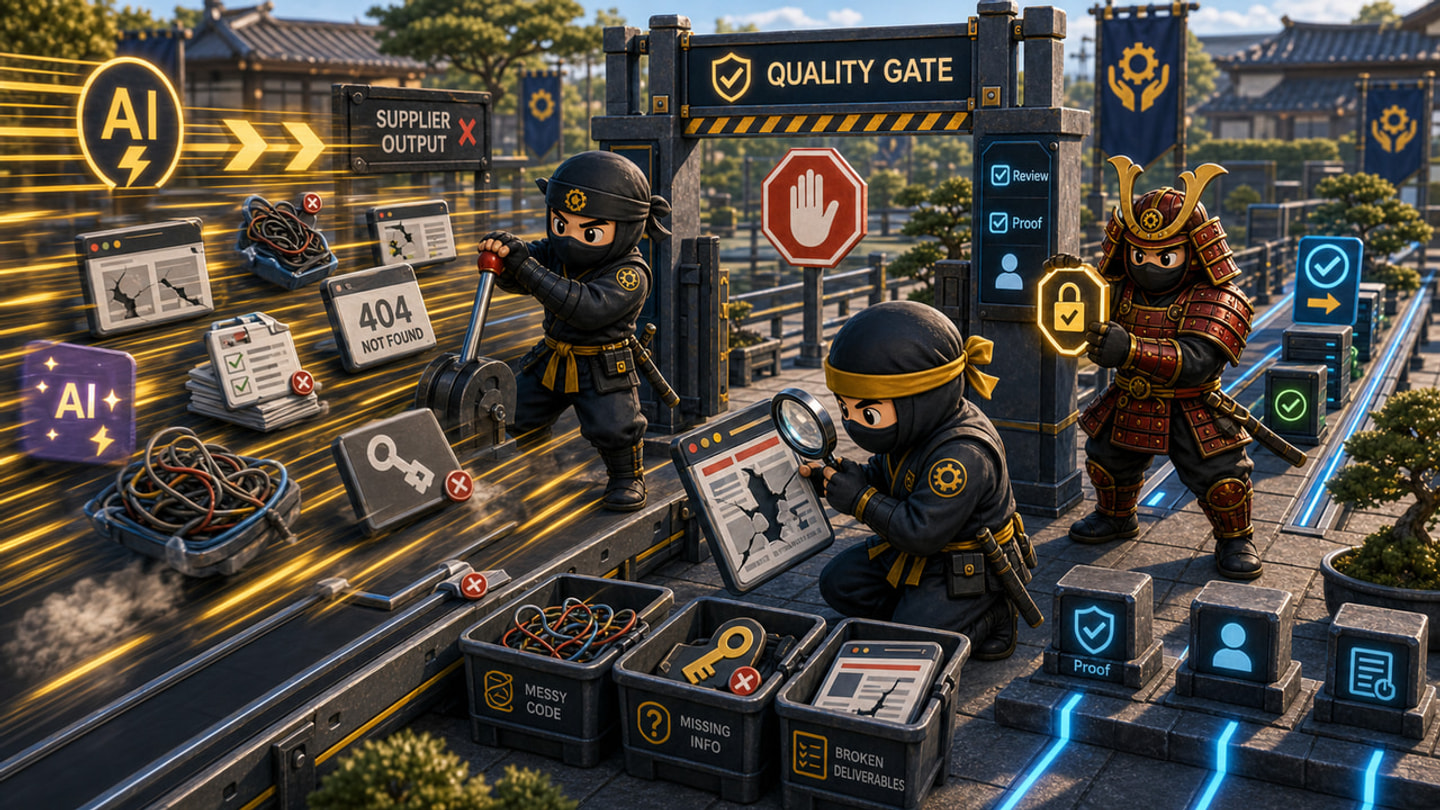

Bad Suppliers do not become good suppliers because they add AI. They become faster. That is useful if the supplier already has judgement, process and accountability. It is dangerous if the supplier was weak before the tool arrived.
AI can produce copy, images, code, plans, reports, emails and automation faster than most teams could a few years ago. But speed does not fix unclear thinking. It does not create responsibility. It does not make a careless vendor understand the business. It simply gives them a bigger machine for producing more output.
If the supplier is bad, AI can make the problem harder to see until later.
Speed Can Hide Weak Judgement
Before AI, weak suppliers were often limited by production time. Bad copy took time. Bad design took time. Bad strategy took time. Now a supplier can produce a large amount of material quickly and make it look complete enough to pass a surface check.
That creates a new risk for business owners. They may receive more pages, more drafts, more graphics or more automation than before, but the work may still be wrong underneath. The supplier has not solved the problem. They have only made the wrong path look busy.
This is why output volume is a poor quality signal. A business should ask whether the work understands the goal, the customer, the system and the risk. If those foundations are missing, faster production only creates faster cleanup.
The same problem appears across different types of work. A supplier can generate ten landing pages that all miss the buyer. They can produce twenty images that technically look polished but do not match the brand. They can create automation that works in the happy path and fails when a real customer behaves differently. The volume feels impressive until someone checks the details.
AI Does Not Replace Ownership
A good supplier can use AI as leverage because they know what to ask, what to reject, what to verify and how the result fits the business. A bad supplier uses AI as a shield. They push work through tools and hope the client will not notice the missing thinking.
Ownership is the difference. Someone still has to decide whether a page is strategically useful, whether a claim is accurate, whether an image matches the brand, whether code is safe, whether automation handles edge cases, and whether the final result helps the business.
That ownership should be visible in the workflow. There should be rules before production starts, review gates after production, and a willingness to reject work that does not pass. If the supplier treats AI output as automatically acceptable, the client becomes the quality-control department. That is not a service. That is a transfer of responsibility.
NinjaWeb has written about this shift in Your Idea Was Worthless. AI Just Made It Valuable Again. AI can increase leverage, but only when execution has discipline behind it.
Cheap Work Can Become More Expensive
The most dangerous AI supplier is not always the one that charges the least. It is the one that produces confident-looking work without understanding consequences. A bad article can damage trust. A bad image can make the brand look confused. A bad automation can lose leads. Bad code can create support work. Bad SEO can fill a site with pages that should never have existed.
The client may feel they are saving money because the supplier is fast. Later, they pay to review, rewrite, rebuild, remove or explain the mess. That is not efficiency. That is deferred cost.
Good AI work should leave a trail. Why was this angle chosen? What rules did it follow? What was checked? What failed? What changed before approval? Without that trail, the client is being asked to trust the machine and the supplier at the same time, with no proof that either one was controlled.
This is close to the problem NinjaWeb has described in Why Fiverr and Upwork Platforms Suck. The issue is not only the platform. It is the lack of responsibility when the work becomes a transaction instead of a controlled outcome.
How NinjaWeb Would Approach It
NinjaWeb would not reject AI by default. The question is whether the workflow has judgement. What is the goal? What rules control the output? Who checks quality? What happens when the result fails? Is the supplier using AI to execute a clear plan, or using AI to avoid having one?
For websites, content, images, SEO and automation, the answer has to be visible in the process. There should be approved strategy, originality checks, brand rules, technical validation, visual review, version history and a clear handoff. The tool can help, but the tool cannot be the person responsible.
AI makes good operators more capable. It makes bad suppliers more dangerous. The business owner should not ask only how fast the work can be produced. They should ask who is accountable for making it correct.