
Recommended Services


Supported Scripts
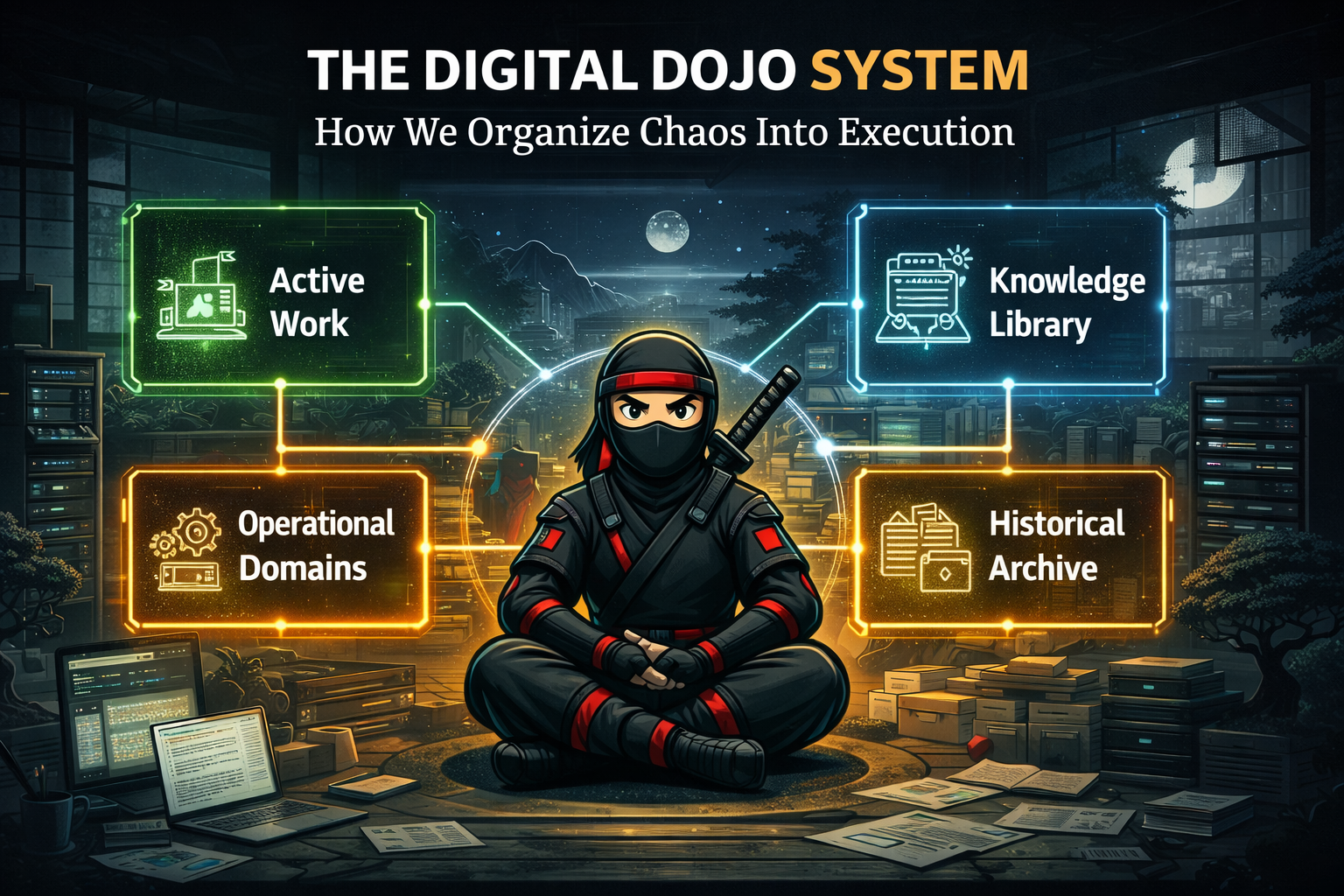

The Digital Dojo System: How We Organize Chaos Into Execution
In digital business, chaos shows up fast. Ideas pile up. Notes get scattered. Client requests come through different channels. Technical knowledge ends up buried in folders, screenshots, emails, or half-finished documents. Before long, you are no longer working efficiently. You are simply chasing information.
The Digital Dojo System is how we solve that problem. It is a practical way to organize ideas, active work, useful knowledge, and completed history so everything has a place and nothing valuable gets lost. More importantly, it helps turn information into execution.
At NinjaWeb, we do not believe in collecting ideas for the sake of it. We believe in building systems that support movement. A good system should reduce noise, improve clarity, and make it easier to act. That is exactly what the Digital Dojo System is designed to do.
Why Digital Work Becomes Chaotic So Easily
Modern work creates constant input. A single week can include project updates, website changes, support issues, server notes, marketing ideas, research links, and content drafts. Each of those pieces may be useful, but without structure they become friction.
That friction costs time. Teams search for files instead of using them. Good ideas disappear because they were never stored properly. Important lessons get repeated because nobody can find the original solution. As a result, the business slows down.
This is why organization matters. However, the goal is not to become overly rigid. The goal is to create enough structure that ideas can move smoothly from thought to action.
What Is the Digital Dojo System?
The Digital Dojo System is a simple framework for organizing digital work into four core layers. These layers reflect how information behaves in real business operations. Some things are active and urgent. Others are ongoing responsibilities. Some are reference material, while others belong in the past but still need to be preserved.
Once you understand these layers, it becomes much easier to store information in a way that actually supports execution.
1. Active Work
Active Work includes anything currently being built, delivered, fixed, launched, or improved. These are live projects with a clear objective and an endpoint. For example, that might be a website build, a migration, a content rollout, a redesign, or a campaign.
This layer needs to stay visible because it affects delivery right now. If active work gets buried under old files and random ideas, momentum drops. Therefore, this area should be clean, current, and focused only on what is moving.
Once the work is complete, it should leave this layer and move elsewhere. That keeps the workspace sharp and prevents clutter from building up.
2. Operational Domains
Operational Domains are the parts of the business that never really end. They are not projects with finish lines. Instead, they are ongoing responsibilities that require maintenance, review, and discipline over time.
Examples include infrastructure, support, finance, content operations, security, client communication, and internal process management. These domains hold the systems that keep the business stable.
Because they are ongoing, they need documentation that can evolve. Procedures, checklists, standards, and recurring notes all belong here. This is where consistency is built.
3. Knowledge Library
The Knowledge Library holds information that is useful, even if it is not tied to immediate work. This can include research, guides, technical references, configuration notes, marketing ideas, tutorials, strategy documents, and lessons learned from previous jobs.
Over time, this becomes one of the most valuable parts of the system. Instead of solving the same problem again and again, you build your own library of tested knowledge. That means less wasted effort and faster decision-making.
For a business like NinjaWeb, this could include WordPress fixes, hosting procedures, SEO notes, automation ideas, infrastructure references, and content frameworks that can be reused later.
4. Historical Archive
The Historical Archive is where completed or inactive material goes. This includes finished projects, old campaigns, previous systems, retired documentation, and work that is no longer active but may still be useful in the future.
Archive does not mean rubbish. It means the item is no longer part of the current battlefield, but it still holds value. In many cases, archived work becomes the foundation for future projects. A completed site can become a template. An old process can reveal what worked and what failed.
By moving completed material into archive, you keep your active environment cleaner while preserving important history.
How the Digital Dojo System Improves Execution
The biggest advantage of the Digital Dojo System is that it reduces friction. Instead of asking where something belongs every time a new idea appears, you already have a structure. Instead of losing momentum hunting through random folders, you know where to look.
This creates speed. It also creates mental clarity. When the system is working properly, your brain no longer needs to act as temporary storage for everything. The structure carries the load, so your attention can stay on solving problems and delivering results.
That is where execution improves. Better organization does not just make things tidy. It makes the business more effective.
Tools Matter Less Than Structure
Many people spend too much time chasing the perfect productivity tool. In reality, the platform matters far less than the structure. A disciplined system will work in Notion, Google Drive, Obsidian, a project board, or even a well-organized server directory.
The important part is not the software. The important part is consistency. A messy tool with powerful features is still messy. A simple structure used properly will outperform a fancy one used badly.
This is why businesses should focus on building a method first, then choosing tools that support it.
The NinjaWeb Perspective on Digital Organization
At NinjaWeb, we see digital organization as part of operational strength. The more moving parts a business has, the more important structure becomes. Websites, hosting, support, automation, SEO, and client delivery all create information. If that information is not organized, growth creates drag instead of momentum.
That is why systems matter. They protect time, improve visibility, and help knowledge compound. They also make delegation and scaling easier because important information does not live only in somebody’s head.
If you are building a modern business, you need more than creativity. You need structure that allows creativity to become output.
How to Start Building Your Own Digital Dojo System
Start small. Do not overcomplicate it. Begin by separating your digital environment into the four layers: active work, operational domains, knowledge library, and historical archive. Then move your files, notes, and ideas into the correct place little by little.
You do not need to rebuild your entire system in one day. In fact, that usually makes things worse. A better approach is to improve the structure gradually while continuing to work. As the system becomes more natural, the clutter starts to drop away.
Most importantly, review it regularly. A system only works if it stays alive. The goal is not perfection. The goal is useful order.
Final Thoughts
The Digital Dojo System is not about being neat for the sake of being neat. It is about making information useful. When ideas are organized properly, work moves faster. When knowledge is easy to find, decisions improve. When completed work is archived properly, experience compounds instead of disappearing.
Chaos will always exist in digital business. New tools appear. Client demands change. Technologies evolve. However, with the right structure, chaos does not have to control the workflow.
The real advantage comes from building a system that turns scattered information into clear action. That is how chaos becomes execution.
If your business needs stronger digital systems, smarter workflows, or a better foundation for web operations, explore our Business Solutions, AI & Automation, and Advanced IT Support services.