


Contact Info
106 Anne Rd, Knoxfield VIC 3180, Australia
+61 (03) 82023009
info@ninjaweb.com.au
Contact usRecommended Services


Supported Scripts
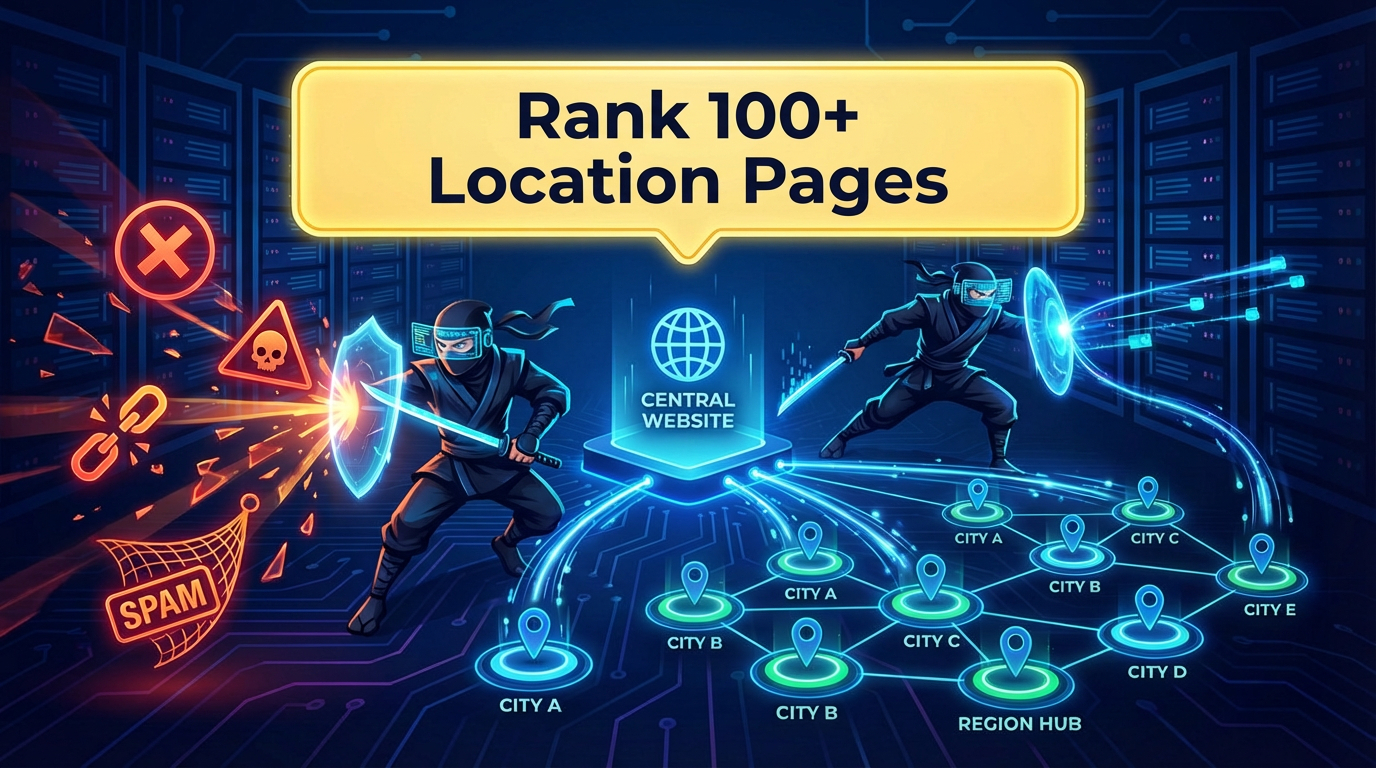

Location page SEO has a bad reputation for a reason. A lot of businesses try to scale it by cloning the same page over and over, swapping out suburb names, then hoping Google will not notice. That lazy approach is exactly how people end up with useless pages, weak rankings, and a site filled with near-duplicate junk. The problem is not location pages themselves. The problem is spammy execution.
Done properly, location pages are one of the most powerful local SEO assets a business can build. They let you target real geographic demand, strengthen relevance across service areas, and create a network of pages that support both users and search engines. Done badly, they become dead weight. Done well, they become a ranking machine.
At NinjaWeb, we build location page systems to scale without crossing into template spam. That means structure, variation, intent alignment, internal linking, real usefulness, and quality control. It is not about producing more pages for the sake of numbers. It is about creating a scalable local SEO framework that still gives Google a reason to trust what it crawls.
The real risk is duplication without value
Google does not hand out penalties just because multiple pages live on the same site and target nearby areas. The real issue is whether those pages are thin, manipulative, and functionally identical. If every suburb page says the same thing with the place name swapped in twelve times, that is weak. It offers no distinct value. It looks manufactured because it is manufactured.
A strong location page should still answer a real need. It should connect the service to the area in a believable way, use location-aware framing where appropriate, and sit within a broader site architecture that makes sense. If the page exists only to catch traffic and has no depth, no context, and no reason to live, it will struggle.
This is why we do not treat suburb pages like disposable SEO bait. We treat them as part of a structured content system that supports local discovery while strengthening the authority of the main service pages.
We build from the service outward
One of the easiest ways to wreck a location strategy is to build local pages without strong service anchors. If the core service pages are weak, the suburb pages have nothing solid to support. That is backwards. We start by making sure the primary commercial pages are clear, useful, and properly targeted. Those pages define the service offering at the top level.
From there, location pages extend the reach of those services into relevant areas. That means a suburb page is not trying to replace the main service page. It is reinforcing it. It provides local relevance while the main service page carries broader topical authority. This relationship matters because it creates a cleaner site hierarchy and a more natural internal linking flow.
That structure works especially well when local pages support services like Web Hosting, Node.js Hosting, Radio Hosting, Business Solutions, and SEO depending on the campaign and search demand.
Variation is controlled, not random
Scalable local SEO does not mean chaotic page generation. It means controlled variation. We use structured content variation across page sections so the network does not read like a stack of clones. Intros change. trust sections change. service explanations change. local framing changes. calls to action change. Supporting transitions change. The point is not to trick Google with synonyms. The point is to avoid building a dead pattern that offers the same reading experience page after page.
Controlled variation also helps preserve brand consistency. A site should still sound like the same company across every page, but not like the same paragraph was photocopied a hundred times. That balance matters. Too much sameness becomes a duplication risk. Too much randomness becomes a branding mess. The sweet spot is disciplined variation tied to the role of each section.
This is one reason large-scale local SEO needs a system, not just content generation. Without rules, quality drops fast.
Each page needs a job to do
A real location page should help the user understand what is offered in that area and why the page is relevant to their search. That might include local service framing, area-specific wording, nearby service references, or stronger paths into the main offer. It does not need to pretend there is an office on every street corner. It does need to provide context and clarity.
We avoid fake locality claims and cheap tricks. Instead, we focus on making the page useful within the site journey. A suburb page might act as an entry point from search, then guide users deeper into the core service page, related articles, industry pages, or conversion paths. That makes the page functional instead of ornamental.
If a page has no purpose beyond ranking, it is weak. If it attracts the right search, supports the service, and moves the visitor forward, it becomes a genuine asset.
Internal linking is where the system becomes powerful
Internal linking is what turns a pile of pages into a ranking framework. A location page should not sit isolated in the dark. It should connect logically to its parent services, nearby locations where relevant, broader category pages, and supporting content that reinforces trust and expertise. This helps Google understand the structure while also helping users navigate naturally.
For example, a strong local page might feed into a main service, a regional hub, a related solution like E-Commerce Websites or Identity & Branding, and an educational article that supports the buying decision. This layered linking keeps authority moving through the site and reduces the chance of orphaned or thin content pockets.
When a site is built this way, the value of each page compounds. That is when large-scale local SEO stops being risky and starts becoming strategic.
Template systems are fine. Template abuse is not.
There is nothing inherently wrong with using templates to scale. Every serious content system uses structure. The danger appears when structure becomes abuse. If the template produces pages that are too thin, too repetitive, or too disconnected from intent, the footprint becomes obvious. Google does not need to find a manual violation to decide those pages are not worth much.
Our goal is not to pretend templates do not exist. Our goal is to use them intelligently. We keep the framework consistent while allowing enough section-level flexibility to preserve usefulness, readability, and variety across the network. We also keep the surrounding site strong so the location pages are supported by real authority instead of floating as a spam island.
That distinction matters. Scale itself is not the enemy. Low-quality scale is.
Quality control matters more as page count grows
Anyone can generate a hundred pages. The real challenge is keeping them worth indexing. As page count grows, weak habits multiply fast. Bad headings, repeated intros, empty paragraphs, broken links, thin CTAs, and poor hierarchy spread across the network if nobody is checking the outputs. That is why disciplined QA is part of the system.
We review structure, variation logic, linking patterns, service alignment, and page usefulness before treating a page set as finished. That is especially important in large local campaigns where small errors can repeat at scale. Quality control is not glamour work, but it is what protects the build from sliding into mediocrity.
A location page strategy should make the site stronger with every rollout, not heavier and weaker.
What actually keeps the strategy safe
What keeps a local SEO build safe is not some magic word count or a superstition about how many suburb pages are allowed. It is usefulness, structure, variation, internal logic, and honest targeting. When the pages serve a real function, support the main services, and avoid duplicate-content laziness, they stop looking like spam and start behaving like a strong local content network.
That is the difference between throwing pages at Google and building a system Google can understand. One is noise. The other is architecture.
If you want to rank location pages at scale without building a digital landfill, NinjaWeb can help forge the right structure from day one. The win is not just more pages. The win is a cleaner system that can grow hard without breaking trust.
Share this Post

WordPress High CPU Fix on LiteSpeed
ninja-master