


Contact Info
106 Anne Rd, Knoxfield VIC 3180, Australia
+61 (03) 82023009
info@ninjaweb.com.au
Contact usRecommended Services


Supported Scripts
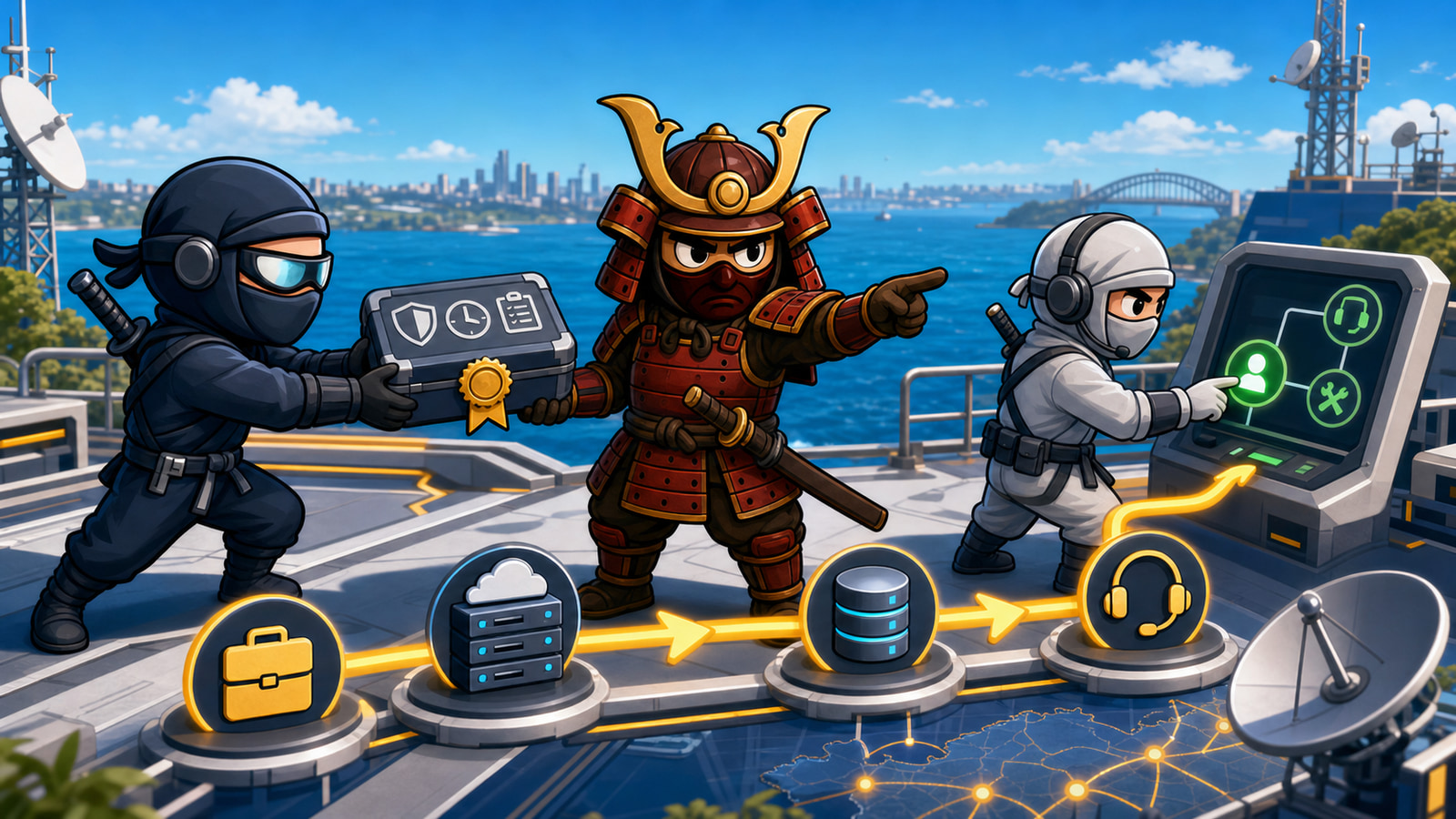

Indian software teams can deliver excellent engineering, product development and platform support for Australian clients. A clear onshore escalation map protects that capability when a serious incident begins and nobody can answer three basic questions: who owns the Australian side, who is authorised to make a decision, and when will the client receive the next useful update?
That map answers those questions before pressure turns them into an argument. It does not replace the delivery team or pretend that every technical task must happen in Australia. It creates a reliable local layer for client communication, infrastructure suppliers, decision authority and evidence handover while the people who know the product continue solving the problem.
That distinction matters. Australian clients are not buying a postcode. They are buying confidence that an incident will have an owner, a response path and a clear end. A capable delivery team becomes easier to trust when its operating model makes that ownership visible.
The Capability Is Not the Problem, the Ownership Gap Is
Offshore delivery is often discussed as if distance automatically causes weak support. That is too simple. A team in India may understand the codebase better than anyone in Australia, maintain stronger documentation and respond faster than a loosely organised local supplier. The real weakness is an ownership gap between the technical team, the Australian client and the services surrounding the application.
Imagine a release that works in testing but causes login failures for Australian customers. The developers can investigate the application. However, the incident may also involve an Australian hosting account, DNS provider, CDN, payment service, email platform or client-side identity system. Someone must confirm the business impact, contact the right supplier, obtain approval for a rollback and keep the client informed while the engineers work.
If those responsibilities are discovered during the outage, every message becomes a negotiation. The client asks the account manager, the account manager asks the delivery lead, the delivery lead waits for an account owner, and several people begin parallel conversations with incomplete information. Technical capability is present, but operational control is missing.
The escalation map closes that gap. It defines people, authority, evidence and communication before an incident. It should fit on one page and be understandable by someone who did not design the system.
Give Every Serious Incident Three Named Owners
A practical model starts with three roles. The same person can hold more than one role in a small engagement, but the responsibilities should remain separate and visible.
- Delivery incident lead: owns technical investigation, coordinates developers, records evidence and recommends the safest repair or rollback.
- Australian escalation owner: receives the local alert, confirms business impact, contacts Australian infrastructure suppliers, maintains the incident timeline and leads the client-facing technical update.
- Client decision owner: approves business-impacting choices such as an emergency rollback, temporary service restriction, customer message or planned recovery window.
Each role needs a primary and a backup contact. A name without an availability window is not an escalation path. Record the normal contact method, the urgent contact method, the hours covered and what happens when the primary person does not acknowledge the incident.
The Australian owner should not become a human forwarding address. That role needs enough access and authority to validate the incident, gather local evidence and move the response forward. At the same time, the person should not make code or product decisions that belong to the delivery team. The map works because it respects boundaries instead of blurring them.
Define Severity Before Pressure Rewrites the Rules
“Urgent” means different things to different people. A broken internal report, a failed checkout and a suspected data exposure cannot share the same response path. Define a small severity model that reflects the client’s actual business, then connect each level to ownership and communication.
| Example level | Business impact | Required response |
|---|---|---|
| P1 — critical | Core service unavailable, active security concern or major revenue path stopped | Activate all three owners, open the incident channel, assess containment or rollback and begin timed client updates |
| P2 — high | Material feature degraded with no reliable workaround | Delivery lead investigates, Australian owner confirms local impact and the client receives an agreed update time |
| P3 — standard | Limited defect with a safe workaround and no immediate business-wide impact | Track through the normal delivery process with a named owner and target review |
These labels are an operating example, not a universal SLA. The team should adapt the thresholds, acknowledgement targets and update intervals to the contract and the client’s risk. The important part is deciding before the incident which conditions activate local escalation.
Severity should also control authority. Can the delivery lead roll back the most recent release without waiting? Can the Australian owner request a temporary firewall change from the hosting provider? Who can approve additional emergency cost? Which changes always require the client? A response slows down when responsibility is named but authority is not.
Map the Australian Dependencies Before You Need Them
The escalation map should include the services that can block recovery even when the application team is ready. For each dependency, record the account owner, support route, verification requirements, service identifier and the person authorised to approve a change.
- Domain registrar and DNS provider
- Australian web hosting, VPS or cloud account
- CDN, web application firewall and security monitoring
- Email delivery and identity services
- Payment, booking or ecommerce platforms
- Backup storage and disaster-recovery systems
- Client-side networks, integrations and data owners
This is not a reason to place passwords in the escalation document. Access should remain in an approved credential system with appropriate permissions and auditability. The map identifies where access lives, who can grant it and which supplier must be contacted.
Local supplier context is valuable here. An Australian escalation owner can confirm the correct account, explain the business impact in the supplier’s support window and keep the delivery team focused on evidence. That person can also stop duplicate tickets being opened by several well-meaning participants.
When personal information may be involved, the map should route the incident to the client’s privacy, management or legal decision-maker. The technical team supplies evidence and containment options; it should not improvise regulatory notifications or make legal conclusions on the client’s behalf.
Use One Incident Brief and One Communication Rhythm
A strong response does not require a complicated incident platform. It requires one reliable source of truth. The first brief should be short enough to complete while the event is active:
- Incident start time and the timezone used
- Affected service, users and business process
- What is known, what is suspected and what remains unknown
- Recent releases, configuration changes or supplier events
- Evidence already captured
- Containment, rollback and recovery options
- Current technical owner and Australian escalation owner
- Decision required, decision owner and deadline
- Time of the next update
The client update should follow the same shape every time: current impact, confirmed facts, action underway, decision required and next update time. “The team is looking at it” is not an update. Neither is a stream of raw logs that forces the client to interpret the incident.
The communication rhythm depends on severity. A critical event may require frequent updates even when the technical position has not changed. In that case, say what has been checked, what remains in progress and when the next checkpoint will occur. Predictability reduces the pressure for side-channel messages and allows the technical team to work.
Keep engineering discussion and client communication connected but distinct. The incident lead needs detailed technical evidence. The client needs an accurate business summary and clear decisions. The Australian owner translates between those views without hiding uncertainty.
Make the Time-Zone Handover an Advantage
India and Australia do not operate on one simple fixed offset. Australia has multiple time zones, and daylight-saving changes affect some states but not others. The map should name the client’s operating timezone and store incident timestamps with an explicit zone. “We will check this tomorrow morning” is not precise enough for a cross-border team.
A disciplined handover can turn the time difference into wider coverage. Before the delivery lead ends a shift, the handover should state the current impact, evidence, actions completed, active hypothesis, rollback position, monitoring state, open decisions and the next named owner. The receiving person acknowledges the handover and becomes responsible for the timeline.
Do not rely on a video call as the record. Calls are useful for fast alignment, but the final decisions and next actions belong in the incident brief. This prevents the Australian owner, the client and the next delivery shift from working from different versions of the story.
The handback matters too. When the Indian delivery team resumes control, it should receive the local supplier responses, client decisions, monitoring results and any temporary changes made during Australian hours. Follow-the-sun support only works when responsibility follows the evidence.
Test the Map Before an Australian Client Tests It
Run a tabletop exercise before the next major launch. Choose a realistic scenario: an Australian customer cannot log in after a release, the application logs are incomplete and the hosting provider must confirm whether a local network rule changed.
Do not repair the fictional defect immediately. First test the operating system around it. Who declares severity? Who opens the incident record? Can the Australian owner reach the hosting supplier? Does the delivery lead have authority to roll back? Who tells the client what is happening? What happens if the primary contact does not respond?
Measure the exercise by clarity, not theatre. Useful findings include a missing backup contact, an expired supplier login, a vague rollback authority, conflicting timezone assumptions or an incident channel nobody monitors. Fix the map, then run it again.
Repeat the exercise when the architecture, client team, supplier stack or delivery leadership changes. An escalation map is operational documentation, not a proposal attachment that remains accurate forever.
Build Local Ownership Without Replacing the Delivery Team
An onshore partnership should strengthen the Indian team, not compete with it. The delivery engineers keep product knowledge, release context and code ownership. The Australian operator owns the local response layer: infrastructure escalation, supplier communication, evidence capture, client-facing coordination and controlled handback.
NinjaWeb can support that model through business systems and operational planning, managed web hosting and Australian VPS infrastructure. The useful starting point is not a vague promise of local support. It is a written map showing exactly what NinjaWeb owns, what the delivery team owns and which decisions stay with the client.
Start with the three named owners. Define severity and authority. List the Australian suppliers and access paths. Agree on one incident brief, one client update rhythm and one shift handover. Then test the arrangement before the next production release.
That is how an Indian software team turns strong delivery capability into stronger Australian confidence: not by pretending distance does not exist, and not by moving every task onshore, but by making ownership impossible to lose when the pressure begins.