


Contact Info
106 Anne Rd, Knoxfield VIC 3180, Australia
+61 (03) 82023009
info@ninjaweb.com.au
Contact usRecommended Services


Supported Scripts
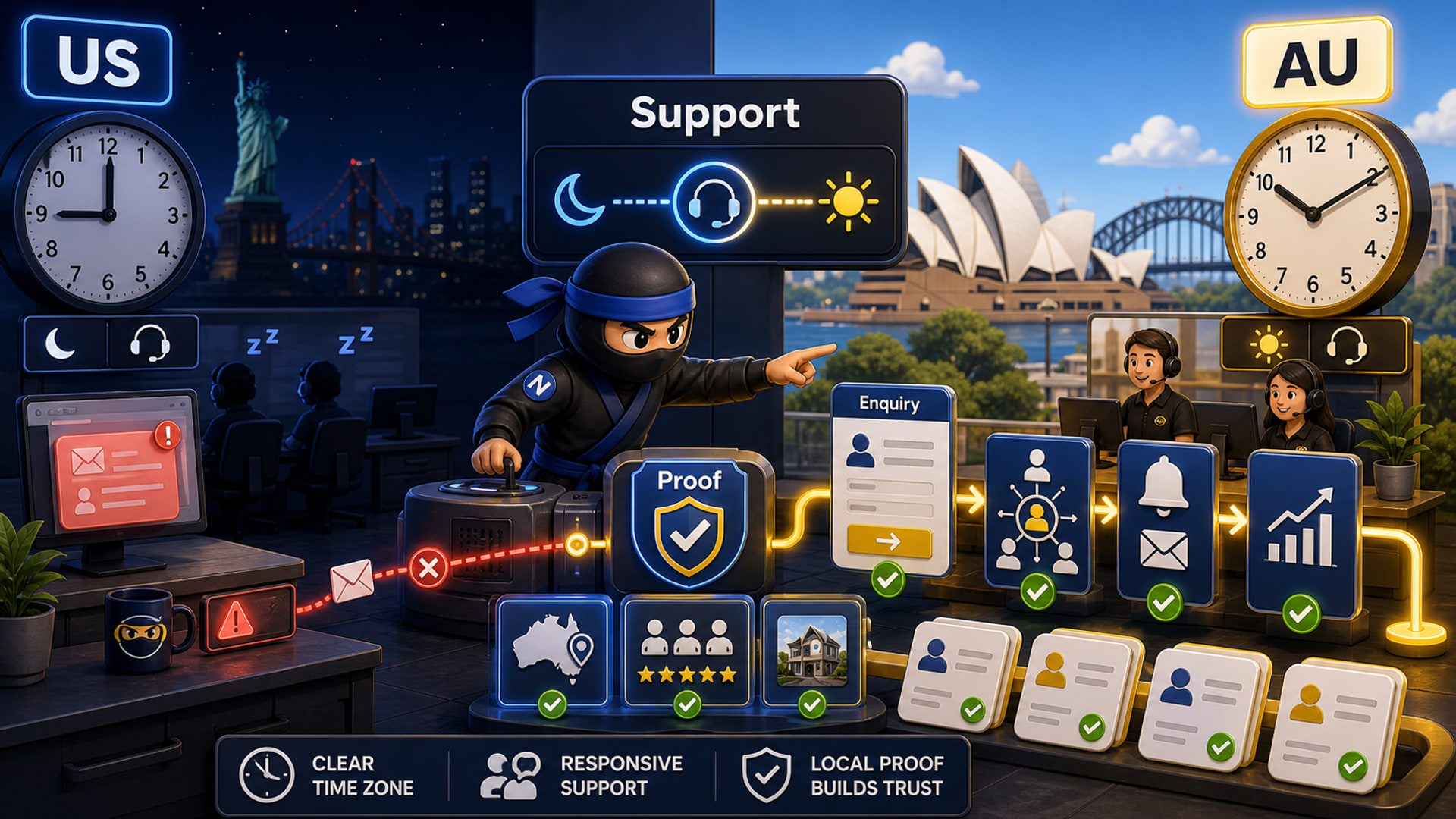

US to Australia market entry needs more than a country selector and a copied landing page. Australian buyers may like the offer, but they still need to understand support windows, local proof, buying process, performance, and what happens after they enquire.
A US company can look established and still feel distant online. The website has to close that distance before sales asks the buyer to trust the business.
Time Zones Affect Buyer Confidence
The time zone question is not only about clocks. It is about whether the buyer believes help will be available when it matters. If support is unclear, the buyer starts imagining delays before the first conversation has happened.
A credible page explains response expectations, booking windows, escalation path, and the difference between sales and support. It should not pretend to have local coverage that does not exist, but it should be clear enough that the buyer knows the operating model.
That clarity is often more convincing than vague global support language and unsupported market-entry confidence.
It also helps the team behind the site. When response promises are written clearly, forms, autoresponders, CRM rules, and staff expectations can be built around the same operating model instead of inventing a new answer for every enquiry.
US Proof Needs Australian Context
American case studies can still be useful, but the page has to explain why they matter to Australian buyers. A logo or testimonial from another market does not automatically answer local doubt.
- Connect proof to a comparable industry or problem.
- Explain the delivery model clearly.
- Place proof near enquiry actions.
- Separate global credibility from Australian relevance.
- Avoid fake local claims that cannot be backed up.
Trust grows when the buyer can see how the overseas experience applies to their own decision.
If there are no Australian case studies yet, the page can still be honest. It can show comparable work, explain what has been adapted for Australia, and make the first local enquiry path feel safe rather than unfinished.
Local proof should also shape the form and follow-up. If the buyer is asking from Australia, the team should receive that context immediately and respond with timing, terms, examples, and a sales bridge that match the market before the buyer loses confidence.
Pricing And Process Need Less Guesswork
Currency, tax language, contract expectations, shipping, onboarding, and billing can all slow an Australian buyer. Even when the offer is relevant, uncertainty around the buying process makes the page feel foreign.
A buyer should not need a sales call just to understand whether the offer can work in Australia.
The page should explain the next step in practical terms. If pricing is quote-based, say what the quote process needs. If onboarding is remote, explain the handoff. If the service depends on location or time zone, ask for that context in the form.
That small amount of process copy reduces friction. It lets the buyer decide whether the conversation is worth starting and gives the business better context before replying.
Performance Makes Distance Visible
Slow pages, heavy scripts, delayed forms, and weak hosting make the distance feel real before the buyer reads the offer. A US business entering Australia should test the experience from Australia, not only from the office network or a US-based tool.
That includes mobile speed, form delivery, media weight, tracking scripts, redirects, and whether the hosting path is stable enough for campaigns. Technical friction can make a serious offer feel careless.
Performance is part of trust because the website is the first service experience the buyer receives.
Campaign pages should be checked again after every major change. A new tracking script, form plugin, CDN rule, or media block can make the Australian experience slower or less reliable without changing the headline at all.
Build A Separate Australian Path
NinjaWeb can help US companies shape a clearer Australian entry path through SEO services, business website planning, web hosting, landing pages, support clarity, and enquiry routing.
The useful test is simple. If an Australian buyer lands on the page today, can they understand support timing, proof, process, performance, and next step without translating the business in their own head?
That means every visible promise needs an operational match behind it. The page, form, autoresponder, hosting, sales owner, and support message should all tell the same story.
If the answer is no, the market entry page is not ready. US to Australia trust is built by removing distance from the buyer’s decision, not by asking the buyer to ignore it.