


Contact Info
106 Anne Rd, Knoxfield VIC 3180, Australia
+61 (03) 82023009
info@ninjaweb.com.au
Contact usRecommended Services


Supported Scripts
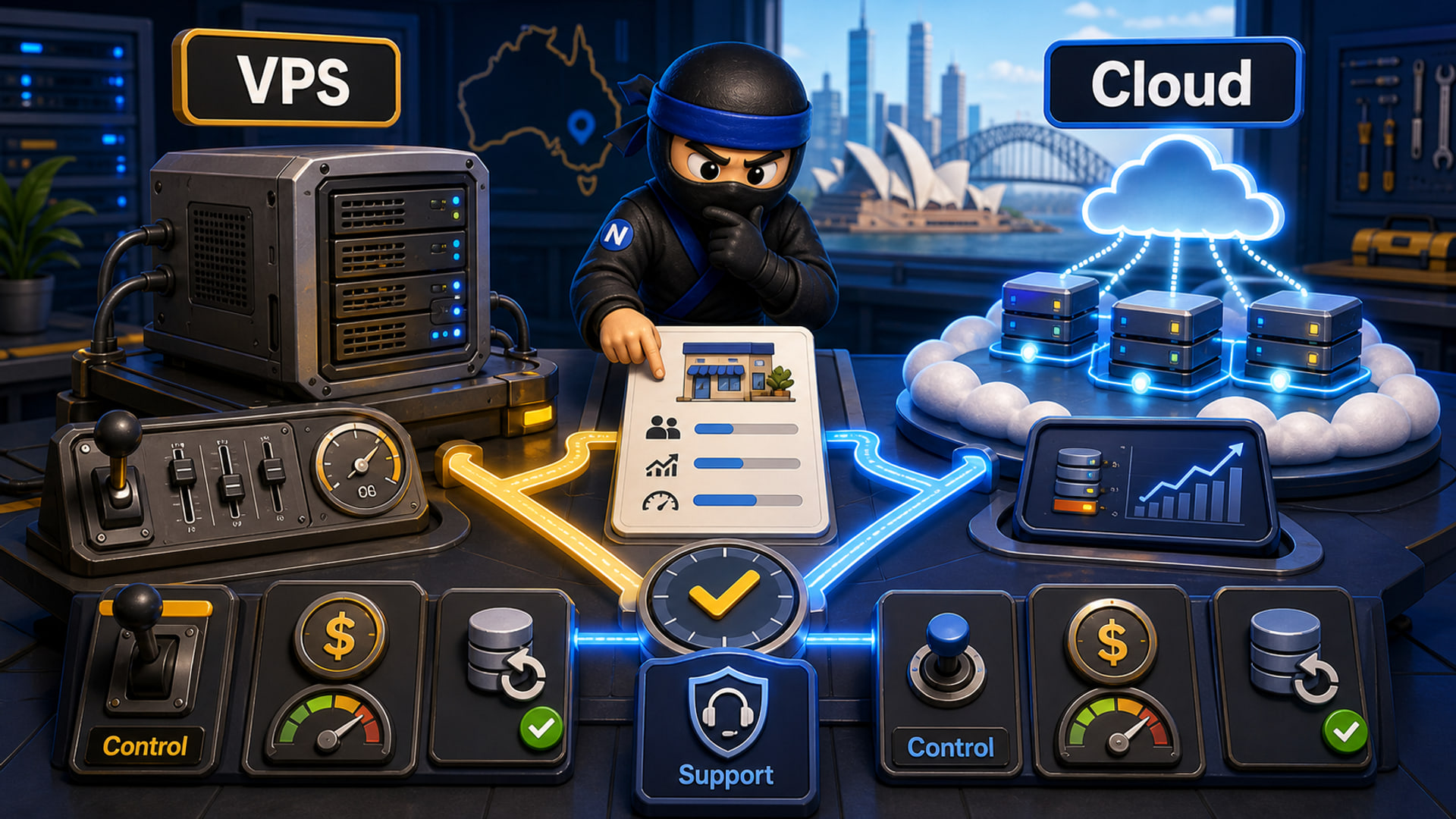

VPS hosting is often the better starting point for an Australian small business that wants control, predictable support, and a clear hosting owner. Cloud hosting can be powerful, but power is not the same as an operating model.
The real question is not which label sounds more modern. The real question is who will manage the server, protect the site, handle updates, watch performance, fix outages, and explain what happens when something breaks.
The Choice Is About Control
A VPS gives the business a defined server environment. Resources are easier to understand, access is clearer, and the support conversation is usually more direct. For many WordPress sites, ecommerce stores, service websites, and business tools, that clarity matters more than abstract cloud flexibility.
Cloud hosting can scale across more complex infrastructure, but the business still needs someone to design, monitor, secure, and pay for that setup properly. Without that owner, cloud can become a confusing bill attached to a system nobody fully understands.
The best option depends on how the business actually operates, not on a fashionable hosting category.
A service business with a WordPress site, enquiry forms, email notifications, and local traffic usually needs a different answer from a software product with deployment pipelines and multiple application services. Putting both under the same cloud promise hides the decision that matters.
Small Business Needs Predictable Responsibility
A small business usually does not want to manage architecture. It wants the website to load, email forms to work, backups to exist, certificates to renew, updates to be handled, and support to be available when something goes wrong.
- Who owns the hosting account?
- Who can access the server during an outage?
- Who checks backups and restores?
- Who watches disk, CPU, memory, and security events?
- Who explains what changed after a migration or update?
Those questions matter whether the label is VPS, cloud, managed hosting, or dedicated infrastructure.
If nobody can answer them, the business has not bought hosting. It has bought a place where the website sits until the next incident exposes the gap.
Cloud Can Be Overkill Without Management
Cloud hosting is useful when the business needs elastic infrastructure, multiple services, deployment pipelines, heavy workloads, or specialised architecture. It is less useful when the business only needs a stable WordPress site and ends up paying for complexity it cannot use.
Cloud is not automatically safer. It is only safer when the architecture and responsibility are clear.
A poorly managed cloud setup can still have slow pages, broken email, missing backups, exposed services, weak permissions, and vague ownership. A well managed VPS can outperform it for the real job the business needs done.
The price comparison should include management time too. A cheap cloud server that needs constant interpretation is not cheap for a business owner. A slightly higher managed plan can be better value if it includes monitoring, backup checks, security attention, and a clear support path.
Performance Depends On The Whole Stack
Hosting is not only the server. A slow site can come from bloated plugins, heavy themes, poor caching, oversized media, bad database queries, remote scripts, DNS issues, or a badly planned migration. Moving from VPS to cloud does not automatically fix those problems.
The hosting decision should include the application layer. If the website is WordPress, the stack should include caching, PHP tuning, database care, security rules, update process, image handling, monitoring, and restore testing.
That is why a smaller, controlled stack often beats a bigger environment with no discipline.
The stack should also match the risk. An ecommerce store needs stronger restore discipline than a brochure site. A lead generation site needs form and email checks. A campaign landing page needs performance under traffic spikes. The hosting model should support those jobs directly, with someone responsible for proving it works before the next busy trading day.
Choose The Model You Can Operate
NinjaWeb can help Australian businesses choose and manage the hosting model that fits the work. That can include Australian VPS hosting, web hosting, managed WordPress hosting, migrations, monitoring, backups, and site-level performance checks.
The practical test is simple. If the site goes down today, can the business name the person responsible, find the backup, understand the server, and restore service without guessing? If not, the hosting problem is not VPS versus cloud. It is ownership.
For many small businesses, the right answer is a well managed VPS or managed hosting setup that someone actually controls. Cloud only becomes the right answer when the business has a real reason to carry the extra complexity.