


Contact Info
106 Anne Rd, Knoxfield VIC 3180, Australia
+61 (03) 82023009
info@ninjaweb.com.au
Contact usRecommended Services


Supported Scripts
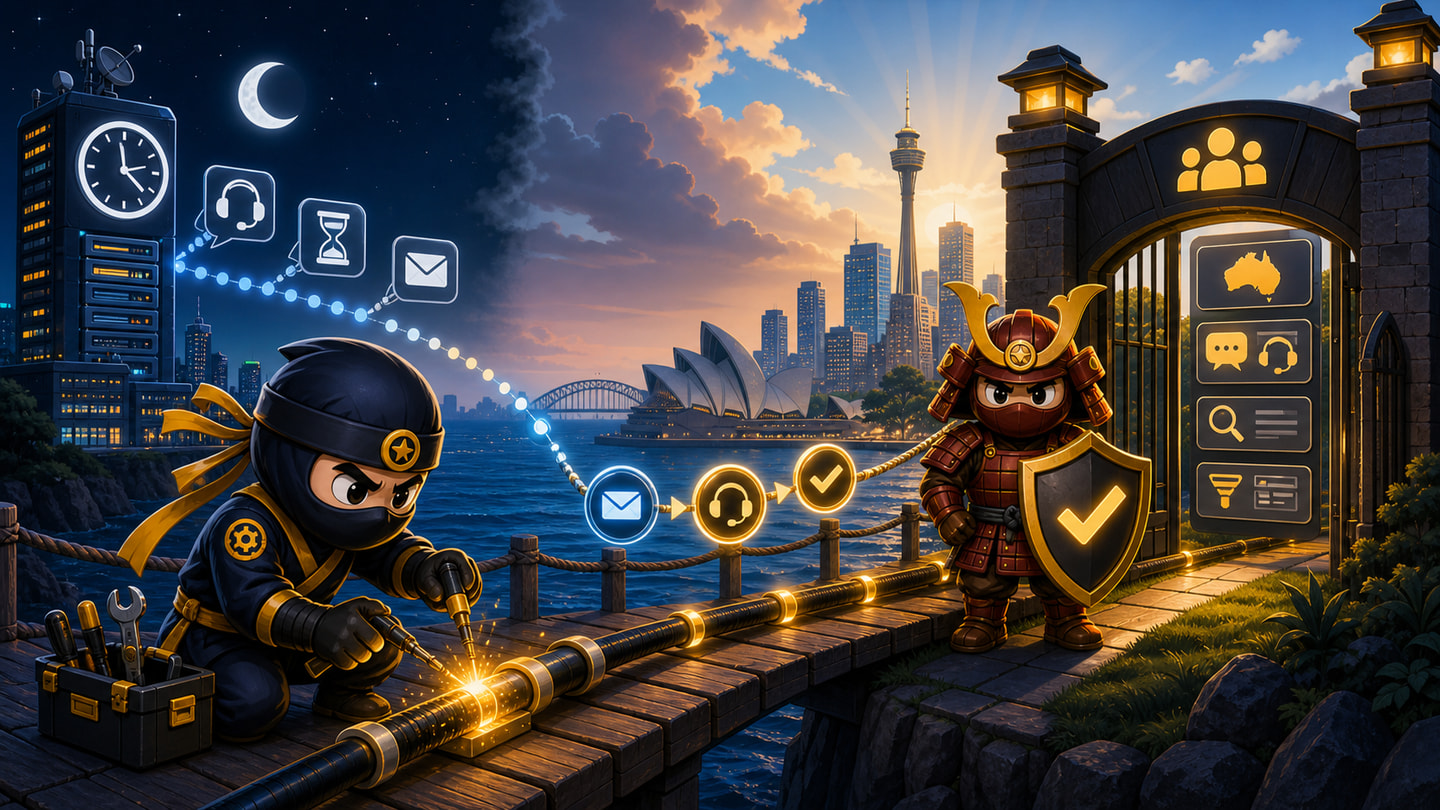

US SaaS Support can lose Australian buyers before the demo even happens. The product may be strong, the pricing may be fair and the sales deck may look polished, but if the support model feels built only for North America, the Australian buyer starts doing risk maths quietly.
That risk is simple. What happens when something breaks during Australian business hours? Who answers? Is support awake? Is escalation available? Are updates written for a different timezone? Does the company understand that an Australian team cannot always wait until tomorrow because the vendor is asleep?
Before an Australian buyer books a demo, they are already checking whether the relationship will be painful.
Timezone Friction Becomes Trust Friction
Timezone difference is not automatically a deal breaker. Many Australian businesses buy from US vendors. The problem starts when the website pretends the difference does not exist. If every support promise is written around US hours, US phone numbers and US assumptions, the Australian buyer has to fill in the gaps.
That is dangerous because uncertainty becomes friction. The buyer may like the product but still worry about onboarding, urgent support, billing questions, downtime, migration help or account management. If the site does not answer those questions, the safest move is to keep comparing.
For B2B SaaS, the competitor is not always a better product. Sometimes the competitor is the vendor that made support risk easier to understand.
The Demo Page Should Not Carry the Whole Sale
Many SaaS companies treat the demo as the moment where all concerns will be handled. That is too late. A serious Australian buyer may never reach the demo if the website creates doubts first. They scan pricing, support, onboarding, security, integrations, case proof and region fit before they hand over contact details.
If the support page is vague, the FAQ is thin and the contact path feels slow, the demo button becomes a bigger ask. The buyer is not only asking, “Can this software help us?” They are asking, “Will this company be there when we need them?”
That question can appear in small details. A calendar that only offers US-friendly times, a help centre with no implementation path, a pricing page that hides billing geography, or a contact form with no response expectation can all weaken confidence. None of those problems prove the product is bad. They prove the buying path is making the Australian reader carry too much uncertainty.
This is similar to the problem NinjaWeb described in US companies selling into Australia. Australia is not just another state. It has its own buying rhythm, distance problem and confidence requirements.
Support Signals Need to Be Visible
A SaaS website does not need to promise impossible 24/7 service if that is not true. It does need to be clear. Australian buyers can accept honest boundaries. They struggle with mystery. Clear support hours, escalation options, onboarding process, help centre depth, response expectations and regional coverage are all trust signals.
Even small details help. Explain whether support is email-only, chat-based or account-managed. Show how urgent incidents are handled. Clarify implementation help. Make timezone expectations plain. If an Australian customer has to calculate everything alone, the site is making the buyer do extra work.
This is especially important when the SaaS touches operations, finance, medical bookings, ecommerce, analytics, marketing, hosting or customer support. The more business-critical the system is, the less tolerant the buyer becomes of vague support language. A demo is easier to book when the surrounding pages already show that the vendor understands business-hour reality.
The goal is not to localise every sentence. The goal is to remove the avoidable doubts that stop the buyer from moving forward.
How NinjaWeb Would Approach It
NinjaWeb would look at the Australian buyer path before changing the design. Which page creates the first support doubt? Is the pricing page clear for international buyers? Does the demo page explain response expectations? Does the site show enough operational proof? Are integrations, security and onboarding explained in the right order?
From there, the work may involve landing page structure, support copy, FAQ depth, internal links, technical performance and clearer conversion flow. The point is not to make the company pretend to be Australian. The point is to make Australian risk visible and handled.
Good decisions under pressure need clear information. NinjaWeb has written about that in Decision Making Under Pressure. A buyer under internal pressure will not wait patiently for a website to explain itself later.
US SaaS can absolutely win Australian customers, but support hours must be treated as part of the trust layer. If the buyer has to guess whether help will exist when the business needs it, the sale is already weaker than it should be.