


Contact Info
106 Anne Rd, Knoxfield VIC 3180, Australia
+61 (03) 82023009
info@ninjaweb.com.au
Contact usRecommended Services


Supported Scripts
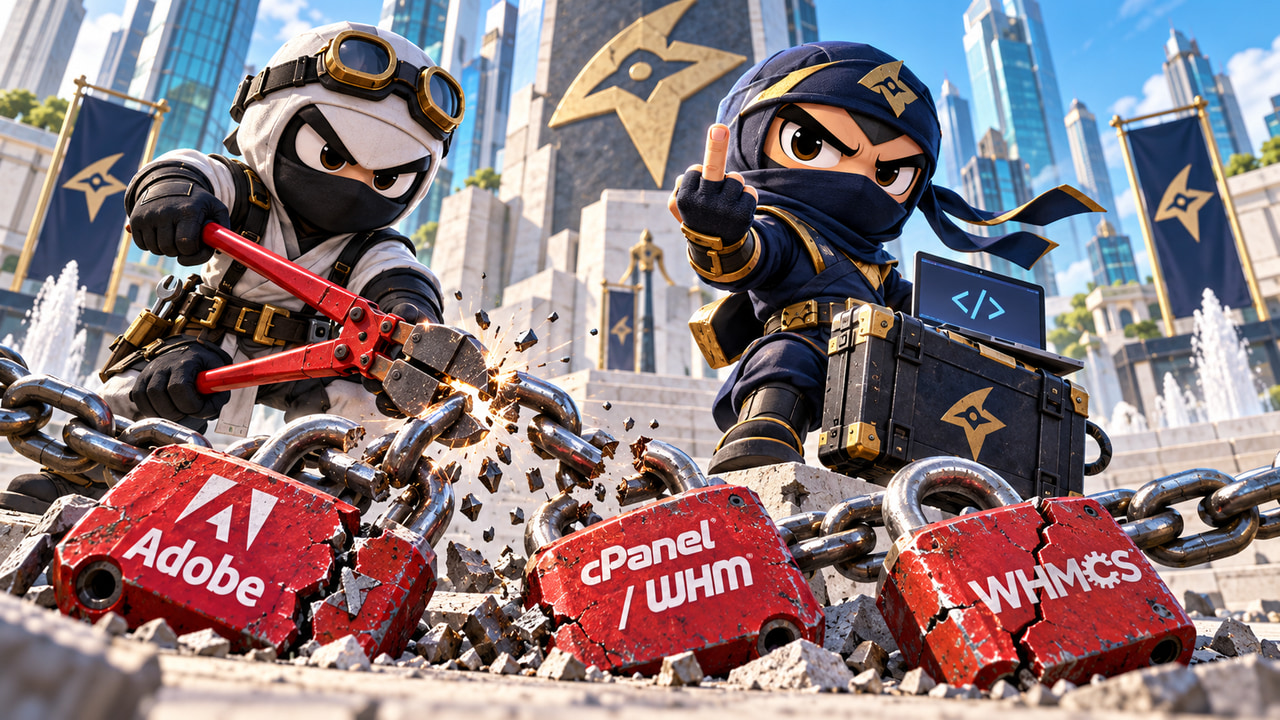

Fuck your subscription. Not because developers should work for nothing. Because a useful product is not a lifetime claim on our wallets, and making it painful to leave does not turn that claim into value.
For years, the software industry sold us convenience, built itself into our workflows and quietly changed the deal. The tool became an account. The purchase became permission. The business we built around it became the reason we could not afford to walk away.
Then the monthly invoice arrived, wearing an innovation badge.
In The Update Is the Cage, we called it renting permission. This is the next chapter: people are building ways out. Actual repositories. Actual applications. Actual alternatives you can download, inspect and test.
The exit is no longer just a complaint in somebody’s comment section. There is code behind it.
Adobe, the Exit Already Exists.
ArtCraft is building free, open-source creative tools. PhotoCraft tackles image editing. VectorCraft tackles vector illustration. FilmCraft tackles video editing. LightCraft tackles non-destructive photography workflows. Those links lead to real projects, not a hypothetical product we hope somebody might eventually build.
Adobe should be shitting itself. People are already building outside its subscription machine.
That does not mean every professional can delete Photoshop tomorrow. The PhotoCraft developers explicitly describe their application as early alpha and say it is not yet a replacement for daily professional Photoshop work. That is a useful admission. It tells you to test your files, exports and essential features before putting a client deadline through it.
It does not make the project worthless. It makes it unfinished. Anyone pretending those words mean the same thing is selling fear, not making a technical argument.
The commercial threat does not require a perfect copy of every Adobe application. A photographer needs their workflow. A designer needs their deliverables. A small business needs the handful of operations it actually performs. If another tool does those jobs reliably, the remaining mountain of features is no longer a reason to keep paying.
You do not own the customer because you own the familiar interface.
If a critic finds broken exports, corrupted files or dangerous code, show the evidence. Fixing those problems makes an alternative stronger. But sneering “AI slop” without demonstrating a failure is not a product review. It is noise. We do not need to invent an organised Adobe campaign to recognise that a dismissive label is a piss-poor substitute for a test.
Download the tools. Try copies of real work. Report what breaks. Contribute where you can. A credible alternative gets built by people using it and improving it, not by waiting for the incumbent to approve its existence.
AI Has Entered the Billing Department. Start Sweating.
“Vibe coding” is a ridiculous name. So is calling a rented desktop workflow a creative cloud. We can survive the terminology. What matters is that AI-assisted development gives smaller teams another way to turn a narrowly defined problem into working software.
The most useful question is often smaller than “Can we replace this entire platform?” Ask whether you can replace the one job that made you buy it. The reporting screen. The file converter. The approval workflow. The integration that moves information between two systems you already pay for.
That is where the invoice starts looking vulnerable. Not because a model magically becomes an engineering department, but because a focused build can be a practical option instead of a fantasy dismissed before anyone estimates the work.
Your pricing page now competes with: “Could we just build this ourselves?”
Testing, security and maintenance belong in that calculation. So do migration effort and the cost of someone taking over later. Count them honestly. Then compare them with years of subscriptions, seat minimums, upgrade gates and workarounds. The honest answer may still be to buy. The important change is that the answer no longer has to be automatic.
That is the work we want to discuss through NinjaWeb’s App Development and AI and Automation: a clear business job, controlled scope, maintainable code and a usable handover. Not a shiny prototype that leaves you dependent on the next person holding the password.
WebPros, This Middle Finger Is for You Too.
cPanel. WHM. WHMCS. WebPros. Hosting operators know this arrangement from the other side of the screen.
cPanel licensing uses account tiers, with additional account charges on Premier. WHMCS’s self-hosted plans use active-client limits. They are different products measuring different things, but both put a counter into the economics of running a hosting business.
Your infrastructure. Your customers. Your support queue. You deal with the outage, chase the payment, handle the migration and answer the ticket. As the relevant account or client threshold changes, the software bill can change with it.
Our growth is not your achievement simply because your software counted it.
Yes, those tools do useful work. That is why people adopted them. It is also why the argument deserves more than “software costs money”. We know it costs money. We run a technology business. The question is whether the renewal earns its place, or survives because replacing years of integrations would be a monumental pain in the arse.
A customer questioning that arrangement is not attacking every developer who wrote the software. They are questioning the arrangement. Explain the value. Defend the price. Compete with alternatives. Do not expect applause because the migration is difficult.
Here Are the Alternatives. Start Building the Exit.
Hosting does not need to wait for one project to arrive wearing an “ArtCraft for servers” badge. Alternatives already exist. But a server control panel and a billing platform do different jobs. Pretending one download replaces both would be the same marketing bullshit we are criticising.
| Project | What it offers | What you still need to prove |
|---|---|---|
| HestiaCP | A free, open-source server control panel for managing web hosting services, including domains, mail, DNS and databases. | Your applications, backup restores, mail operations and provisioning integrations work with the stack you intend to run. |
| ISPConfig | An open-source hosting control panel supporting single-server and multi-server management, with administrator, reseller and client access levels. | Its operating model and migration path fit your fleet and the services you sell. |
| Paymenter | An open-source billing platform built for hosting companies, released under the MIT licence, with an extensible architecture. Its source can be inspected, modified and adapted to your operation. | Your required gateways, provisioning extensions, invoicing, subscription lifecycle and customer-data migration work end to end. It is a billing candidate, not a replacement for the server control panel itself. |
| FOSSBilling | Free, open-source billing and client management with hosting provisioning and an extension system. | Your payment gateways, registrar modules, taxes, renewals and historical records survive a realistic migration test. |
| Blesta | A commercial, self-hosted billing alternative offering unlimited clients and both monthly and owned licence options. Standard owned licences include a limited initial period of support and updates, with renewal options. | The licence terms, update costs and integrations suit your business. An owned licence is not the same thing as an open-source project. |
These are routes to evaluate, not a claim that we have migrated your particular business to them. Put one candidate in a test environment. Reproduce a real customer journey: order, payment, provisioning, renewal, cancellation and recovery. For a panel, test a website migration, DNS, mail delivery and a backup restore. Write down what failed and what replacing it would cost.
That is how “we cannot leave” becomes a list of specific engineering tasks. Some will be expensive. Some will be surprisingly small. Either result is more useful than treating the incumbent’s invoice as a law of nature.
Nobody sensible wants an untested weekend project holding root access or inventing what happens to customer money. Build the exit properly. The difficulty is a reason to do the work carefully, not a reason to stay bent over forever.
Politicians Do Not Get a Free Pass.
This contempt for accountability does not stop at a software checkout. Politicians and governments deserve the same hard questions whenever they demand access, secrecy and trust while resisting scrutiny of their own actions.
Around the world, investigations have exposed politicians’ hidden offshore wealth and spyware used against people who challenge power. Different scandals, the same demand: show us the money, show us who authorised the surveillance, and make anyone responsible for theft or abuse answer for it. Instead, accountability too often disappears into denials, delays and another investigation nobody in power seems in a hurry to finish. People are expected to swallow the revelations, pay their bills and carry on as if nothing happened. What kind of rotten arrangement demands transparency from the public while letting the powerful hide their money and reach into other people’s private lives? Exposure without consequences is not accountability. It is permission to keep going.
To any politician who thinks public office entitles them to invade private lives and dodge accountability: get fucked. Public power is not your personal backdoor.
AI can help people search documents, compare statements and inspect code. It can also manufacture convincing bullshit. It does not turn suspicion into evidence. The useful challenge to power comes when better tools help people check a claim, preserve the record and ask a question that cannot be answered with another rehearsed paragraph.
Less blind trust. More inspectable systems. More evidence. More consequences for abuse. That standard belongs in a ministry just as much as it belongs in a software company.
Build an Exit, Not Another Leash.
There is one spectacularly stupid way to handle this: escape one subscription, then build the replacement inside a platform that controls your code, deployment, data and ability to keep operating.
Congratulations. Different logo. Same leash.
An exit is useful when the source is accessible, the data can be exported, the system can be restored and another competent team can maintain it. If only one person or vendor can make it work, you have moved the dependency rather than dealt with it.
Keep ownership and maintenance separate in your head. Owning code does not patch it. An open-source licence does not guarantee competent operations. Paying somebody to maintain a system can be money well spent. What matters is that the relationship is useful and replaceable, rather than held together by a threat to your ability to work.
Greed. That Is What This Is.
Here is our verdict on the model we have described: greed. Every company that treats a trapped customer as an opportunity to squeeze harder belongs in that sentence. They can dress it up as a pricing strategy, a new tier or an improved customer experience. We see an attempt to extract more because leaving is difficult.
There is a Greek expression for this: trying to squeeze fat out of a fly. Nothing is too small to monetise. Another seat. Another account. Another client. Another gate between you and work you could already do. The customer’s inconvenience becomes acceptable collateral as long as the next invoice gets bigger.
Greedy bastards. You would squeeze the last penny out of people and then charge them for the squeeze.
We are not talking about the developer fixing a bug or the support engineer doing an honest shift. We are talking about the decisions that turn useful software into permanent financial pressure, then expect the people carrying that pressure to say thank you. A business should not have to organise its future around how much punishment a supplier thinks it can tolerate.
Adobe. WebPros. Every vendor relying on that dependency: start preparing. The people you trained to calculate the cost of staying are learning to calculate the cost of leaving. Paymenter, ArtCraft and the other projects here give that calculation somewhere concrete to begin.
Some customers will migrate. Some will contribute to open-source tools. Some will build exactly what they need. The alternatives have to work, and the engineering still has to be done. But every workable exit removes another piece of the hold you have over them.
Shove the captivity model up your arse. We have better things to build than your next price increase.
Fuck your subscription.
We’ll build our own.